Your Economy and Building
Ships win battles, but credits and factories win games. This chapter covers where your money comes from and everything you can spend it on.
Where credits come from
Your treasury (measured in credits, shown as c) grows every production cycle. In
each cycle, every star you own pays its wealth into your treasury. Wealth is recurring —
the star keeps it and pays again next cycle — so the more (and wealthier) the stars you hold,
the faster your bank grows.
Your treasury is shared across your whole empire. There is no per-star budget; credits earned anywhere can be spent anywhere.
What you can buy
Nova divides purchases into two groups:
- Build — improvements to a specific star you have selected (factories and shields).
- Upgrades — improvements to you, the commander (speed, range, battle power), which apply to everything you do.
Plus two special operations launched as units — spy probes and nova bombs — covered in the next chapter.
Here is the full default price list:
| Purchase | Cost | Effect |
|---|---|---|
| Factory | 5 c each | +1 ship per production cycle, on that star |
| Speed upgrade | 80 c (+0.1) | Fleets travel faster (commander-wide) |
| Range upgrade | 100 c (+1) | +1 parsec of jump range (commander-wide) |
| Battle power | 20 c (+1) | Stronger in every battle (commander-wide) |
| Probe shield | 10 c | Blocks enemy spy probes on that star |
| Nova shield | 200 c | Blocks nova bombs on that star |
| Spy probe | 10 c | Scouts a star's defences (see next chapter) |
| Nova bomb | 200 c | Destroys a star (see next chapter) |
| Jump gate | varies — distance × added speed | A permanent fast link between two stars you own (see Jump Gates) |
| Upgrade jump gate | varies — distance × added speed | Raise an existing gate's speed (charges the difference) |
Prices can vary by theatre. The table above lists Nova's standard prices. When a theatre is created, its host can open Purchase costs on the New game form and set a custom price for any of these — making nova bombs cheap, factories expensive, or anything in between. Those prices then apply to that theatre for its whole life, so always check the actual cost on the buttons in the game you are playing; it may not match the defaults here.
Building on a star
Select one of your stars and look at the Build section of the Contact panel.
Factories
Factories are the best investment in the game. Each one builds one ship every production cycle on the star it sits on, forever. Two buttons add them:
- + Factory — adds one factory (5 c).
- + 5 — adds five factories at once (25 c).
A star with many factories becomes a shipyard, pumping out a steady stream of reinforcements. Concentrate factories on safe, wealthy stars where they will not be captured before they pay off.
Important — "+5" builds factories, not ships. There is no way to buy ships directly in Nova. The +5 button adds five factories; ships come only from those factories producing over time (or from moving ships you already have). If you need ships now, you must build factories ahead of time and let them work.
Shields
Two shields protect a star, each a one-time purchase:
- Probe shield (10 c) — stops enemy spy probes from learning anything about the star. Good on stars whose true strength (or weakness) you would rather keep secret.
- Nova shield (200 c) — stops a nova bomb from destroying the star. Expensive, but the only defence against having a key world erased from the map.
The shield buttons only appear if the star does not already have that shield. Shielded stars show a coloured ring on the map (green for probe, amber for nova).
Upgrading your commander
Open the Command panel to see your global stats — treasury, total ships, range, speed, and battle power — and the three upgrade buttons:
- Speed +0.1 (80 c) — every fleet you ever send arrives sooner. It is permanent and applies to your whole empire, so it is priced to match: a little speed is a real investment.
- Range +1 (100 c) — every star can reach one parsec farther, widening your direct-strike options and your routing network.
- Power +1 (20 c) — you fight better in every battle, attacking and defending.
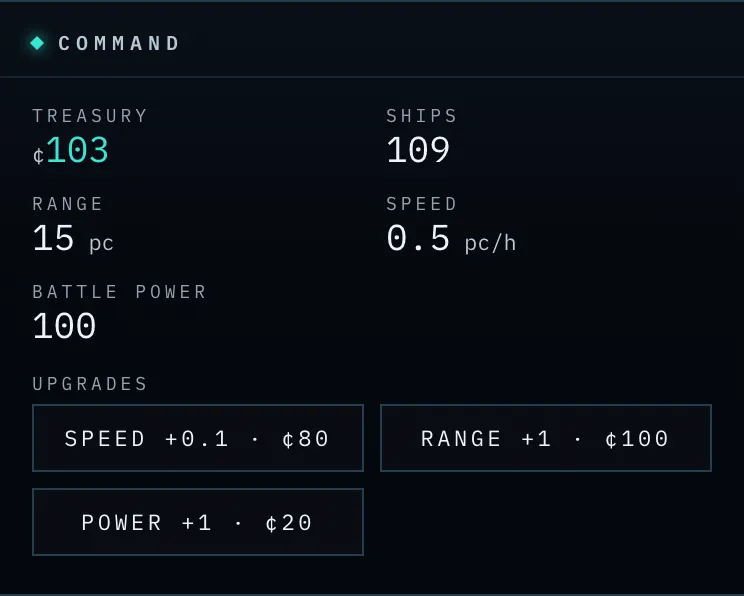
Screenshot: the Command panel showing Treasury, Ships, Range, Speed, and Battle power, with the Speed / Range / Power upgrade buttons.
Because upgrades are commander-wide and permanent, they compound: a speed or battle-power lead bought early pays off in every fleet and every fight for the rest of the game.
Buy upgrades where you need them. All three upgrades — speed, range, and battle power — can be bought from the Command panel, from a star's details panel, and right on the Send fleet dispatch screen, so you can strengthen your fleets without leaving the star or order you're working on. On the dispatch screen the travel estimate updates on the spot, so you can watch a destination come into range, or a trip get shorter, before you launch.
Spending wisely
A few rules of thumb (the Strategy chapter goes deeper):
- Factories first. Early credits spent on factories snowball into more ships and — because more stars means more wealth — more credits. It is the core feedback loop of the game.
- Buy range or speed when geography fights you. If targets sit just outside your reach, a range upgrade opens them up; if your fleets always arrive too late, speed helps.
- Battle power if you plan to brawl. A commander who intends to fight a lot gets more from battle power than from raw numbers alone.
- Shields are insurance. Spend on them to protect the stars you cannot afford to lose, not on every world.
- Watch your committed cash. Credits earmarked for spy probes and nova bombs that haven't launched yet are not available to spend twice — Nova tracks this for you.