Special Operations
Beyond ordinary fleets, Nova gives you two specialist units — the spy probe and the nova bomb — and two shields to defend against them. Used well, they turn the fog of war and the map itself into weapons.
Spy probes — seeing through the fog
A spy probe is a cheap, fast unit that scouts a single star. Launch one like a fleet (select your star, choose Spy probe, pick the target), but note:
- It costs 10 credits, not ships.
- It travels at double fleet speed, so it scouts quickly.
- It flies directly to the target, so the target must be within your range.
When the probe arrives, if the star has no probe shield, it reports back:
- the star's wealth,
- its ship count,
- its factory count, and
- whether it has a nova shield.
That intelligence then appears on the map as an amber, tilde-marked label (e.g. ~8:14)
and in the Contact panel when you select the star. It is a snapshot from the moment the
probe arrived, so treat it as a recent estimate, not a live feed — defenders may have changed
since.
If the star has a probe shield, the probe is blocked — but it still reports back something useful: that the star carries a probe shield. Nova marks that star with a green ring on your map so you remember it is shielded. (Any numeric intel you gathered from an earlier successful probe of the same star is preserved.)
There is one catch for the spy. A probe that gets through an unshielded star is covert — the owner is never told they were scouted. But if the star has a probe shield, the shield's owner is alerted that someone (and who) tried to spy on them. Scouting a shielded world thus tips your hand; scouting an open one does not.
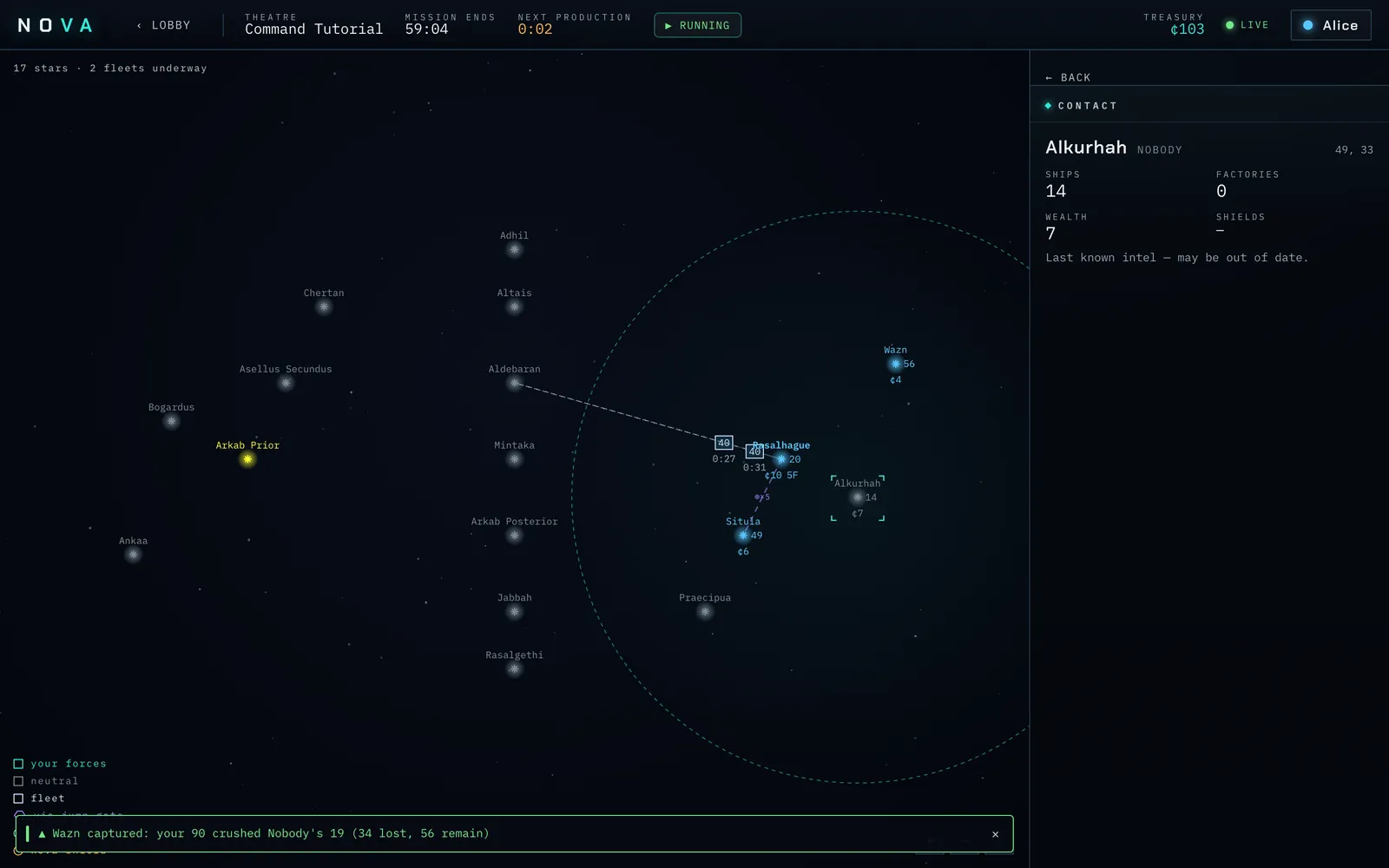
Screenshot: a scouted enemy star showing amber ~wealth:ships intel and the Contact panel
populated from a probe report.
Tip: Scout before you commit. A 10-credit probe can save you a 200-ship fleet by telling you whether a target is a soft expansion or a fortress.
Nova bombs — erasing a star
A nova bomb is the most destructive weapon in the game. Launch it like a probe (select your star, choose Nova bomb, pick the target). It:
- costs 200 credits,
- travels at double fleet speed, and
- flies directly to its target (which must be within range).
When it arrives, if the star has no nova shield, the star is destroyed: it becomes a permanently dead star — owned by nobody, producing nothing, and impassable. Any fleet that later arrives there is lost to a "fiery death," and the star can never be captured or rebuilt.
This is a one-way action. It cannot be undone. The confirm button is coloured red as a reminder.
If the star has a nova shield, the bomb is wasted — the star survives untouched.
Either way, the target's owner is alerted when the bomb lands — told whether their nova shield held or their star was destroyed. Unlike a covert spy probe, a nova bomb always announces itself to its victim.
Why destroy a star?
Destroying a star denies it to everyone, including its owner. That can be powerful when:
- a rival holds a fortress you cannot take but cannot allow them to keep,
- a star is a critical routing waypoint in a rival's territory (kill it and their fleets can no longer hop across the gap), or
- the game is close and removing a rival's star counts directly against their final score.
But remember the win condition rewards holding living stars — a star you blow up helps no one's total, including potentially your own plans to capture it. Nova bombs are a tool for denial, not growth.
Shields — defending against both
For each of these weapons there is a matching shield you buy on a star (see Your Economy and Building):
- Probe shield (10 c) — enemy spy probes that reach the star learn nothing. Your numbers stay secret, so rivals must attack blind. Cheap enough to spread across your front-line worlds.
- Nova shield (200 c) — the star cannot be destroyed by a nova bomb. The only protection for a world you cannot afford to lose. Reserve it for your most valuable stars — a heavily developed shipyard, a key waypoint, your capital.
Your shielded stars show a ring on the map: green for a probe shield, amber for a nova shield. Both kinds of shield are discoverable by a rival who scouts you: a successful spy probe reveals a nova shield in its report, and a probe blocked by a probe shield tells the prober the star carries a probe shield (drawn as a green ring on their map). So a determined scout can learn which shields a star has — though a probe shield still does its job of hiding your numbers, and still alerts you when it blocks a spy.
Tip: Probe shields are as much an offensive tool as a defensive one — a shielded star whose strength the enemy cannot read is a star they will hesitate to attack, or will attack with the wrong-sized force.
A note on standing orders and nova bombs
If a star that is the origin or destination of one of your standing orders is destroyed by a nova bomb (or lost in battle), that standing order is automatically cancelled. See the next chapter.